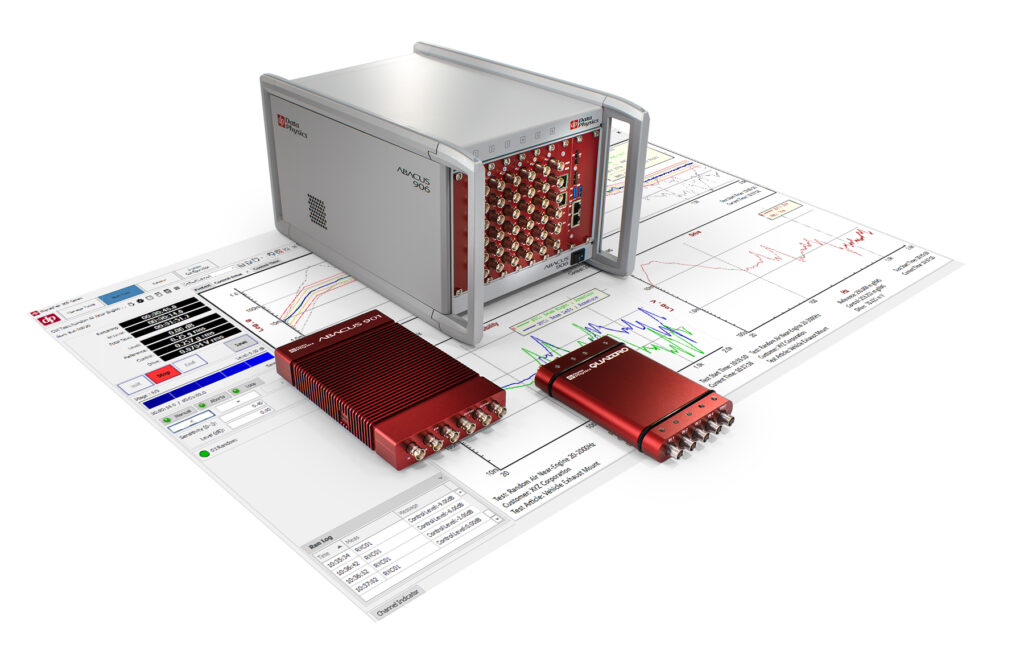
Compact and rugged, the 900 Series hardware is designed for the most demanding field or lab applications. With a modular, distributed architecture, the 900 Series can be expanded to over 1,000 channels for laboratory use. Read more on impact testing with the 900 Series.
The new Abacus 900 Series hardware platform is a powerful, real-time, distributed digital signal processing system. The Gigabit Ethernet network architecture allows the systems to be used independently or combined to create larger systems with over 1,000 channels. Systems are comprised of channel cards with up to six channels per card. Two channels on each card are reconfigurable by the user as inputs, outputs or tachometers, allowing the system to be configured as needed for each test. Constant improvements have allowed the hardware warranty to be extended from 1 year to 3 years with the purchase of any new 900 Series system.
Up to 216 kSamples/s for 80 kHz of alias-free bandwidth
24-bit analog-to-digital conversion with up to 144 dB dynamic range
Channel-to-channel phase accuracy of better than 0.5 deg at 40 kHz
The Abacus 901 is an ultra-portable dynamic signal analyzer well-suited for both laboratory and field use. Multiple systems can be combined for larger tests.
Six channels (input/output/tach)
Passive cooling for silent operation
Power over Ethernet
Remote and autonomous operation
Abacus 906
The Abacus 906 is a compact, durable system which supports both voltage/IEPE and strain/bridge sensors. Multiple 906 and 901 systems can be combined to create larger systems.
Up to 36 voltage or 24 strain/voltage channels (or a combination of the two)
Multiple systems can be daisy-chained – expandable to over 1,000 channels
Flexible input/output/tach configuration
Quiet mode for acoustic applications
Abacus 912
The Abacus 912 is the latest Data Physics Analyzer/Controller that can be expanded to accommodate any size test.
The 900 Series is designed for demanding field or lab applications and can be expanded to over 1,000 channels, making it ideal for high channel count data acquisition.
Up to 72 channels per chassis – expandable to over 1,000
The Quattro API Enables the USB-Based Quattro to Provide Vibration Data Acquisition Directly to MATLAB®, LabVIEW, or Any Application That Can Access a C Library
Configure Acquisition Parameters within MATLAB
The Quattro Acquisition Library is launched from MATLAB with configurable parameters such as:
Sample rate (Max 102kHz, 204kHz optional)
Number of Inp/Out Channels
Input Channel Coupling (ICP/IEPE, AC, DC, Single Ended, Differential)
The Quattro Acquisition Library runs in the background while MATLAB performs other tasks – and stores data in a buffer until it is requested by MATLAB.
The size of the internal buffer is configurable, and the Quattro Acquisition Library supports very large buffers as it runs in a 64 bit environment. The internal buffers can store hours of data at 102kHz – limited only by the available system memory.
New 3.2 Software Release
More Advancements and Enhancements Designed to Improve your Test and Measurement Performance
Explore the power of the SignalCalc 900 Series software – with no hardware required. Run simulated tests, review results, and generate reports exactly as you would in a live environment.
Data Acquisition • Signal Analysis • Vibration Control
The new SignalCalc 900 Series software makes the process of defining a test, making measurements, analyzing data and generating high-quality reports easier than ever before. All setup, project, test article, and customer information is saved along with measurement data in a database. Easily search for data from different test runs and test types for analysis and report generation.
Manage tests and data using the built-in relational database
Streamline testing by running multiple simultaneous real-time measurements
Define custom real-time signal processing functions using mathematical operations, including, integration, differentiation, addition, subtraction, multiplication, division, matrix operations, filters (low pass, high pass and bandpass), Fourier Transform, Inverse Fourier Transform
Generate high-quality custom reports
Enhanced Signal Analysis Tools
The SignalCalc 900 Series has a unique ability to add signal analysis measurements to a vibration control test. For example, narrowband FFT, third octave, and histogram measurements can run simultaneously with the vibration control test.
These measurements are configured using independent sample rates, bandwidths, block sizes, etc. Independent acquisition, analysis and control systems with separate hardware are no longer required. Signal analysis measurements are immediately available, removing the delay of waiting for post-processing of recorded data.
User-Defined Real-Time Signal Processing
SignalCalc 900 Series signal processing tools set includes user-defined custom signal processing. These algorithms are processed during the test in real-time using the embedded digital signal processors in the 901 hardware. The results of these algorithms may be displayed during the test and saved with test data. User-defined signal processing options include:
Channel Math
Creation of “User Channels” using mathematical operations on time-domain signals from input channels: Integration, Differentiation, Addition, Subtraction, Multiplication, Division of Channel, Matrix Math, Low Pass, High Pass, and Band Pass Filtering.
Signal Math
Creation of “User Signals” using mathematical operations on processed time and frequency domain signals: Addition, Subtraction, Multiplication, Division, FFT, IFFT, CFFT, ICFFT.
1 Math Channels
Math channels appear in setups, graphs, and data with physical channels. All related signal processing for the measurement or control are also performed on Math Channels.
2 Combine Math Operations
Use multiple math operations in a single function to build virtual channels.
Network Access to Multiple Tests
Multiple workstations can connect and disconnect to a test in process. With proper permissions, users can remotely connect, configure, run, transfer control, and monitor multiple tests.
Include readouts including test parameters, customer and test article name, operator, test time, etc
Overlay Data
Data from one or more runs can be overlaid in Review Mode within seconds. The overlaid plots can be placed in a report.
Data Export
Sweep data can be exported automatically at the end of a test.
Create Custom Report Templates in Microsoft Word
Create a report template in Microsoft Word and have SignalCalc 900 populate the report parameters, plots, and images automatically after each test (DP900-68)
Images and Media
Attach images of the test article or setup and have them printed in the report
Generate Reports Anywhere
Generate Reports on the PC that conducted the test, or on any networked PC
Access SignalCalc Dynamic Signal Analyzers Literature